EventStorming Services / Facilitator Program
Facilitator Program
Build EventStorming facilitation capability inside your team, so the energy keeps flowing long after Paul steps away
Discuss a Program EventStorming Services / Facilitator Program
Build EventStorming facilitation capability inside your team, so the energy keeps flowing long after Paul steps away
Discuss a ProgramTeams and consultancies who want EventStorming to become part of how they work, not just a one-time intervention.
You want to bring EventStorming into your client engagements alongside your own facilitators. Paul co-delivers with your cohort in the room on a real customer problem, then fades back as your team carries the work forward independently.
You want internal facilitators who can run sessions on your product roadmap, onboarding, or enterprise customer rollouts without booking an outside consultant every time.
You are building internal tools and value streams that need collaborative modeling, and you want the practice to spread, not stay bottlenecked on one person.
You want a repeatable way for teams across the organization to surface assumptions, align on language, and discover where to invest next.
PHASE 1
One on-site engagement, three days back-to-back. Days 1 and 2 teach the EventStorming curriculum. Day 3 flips it: the cohort facilitates on your own business processes while Paul coaches in the moment.
Curriculum day. The cohort learns Big Picture EventStorming and Process-Level modeling through Paul's teaching material and structured exercises. Paul names each facilitation move as he makes it so the cohort can replicate it later.
Curriculum day. The cohort goes deeper into Design-Level modeling, bounded contexts, and how to move from an EventStorming wall to solution decisions, continuing with structured teaching and hands-on exercises.
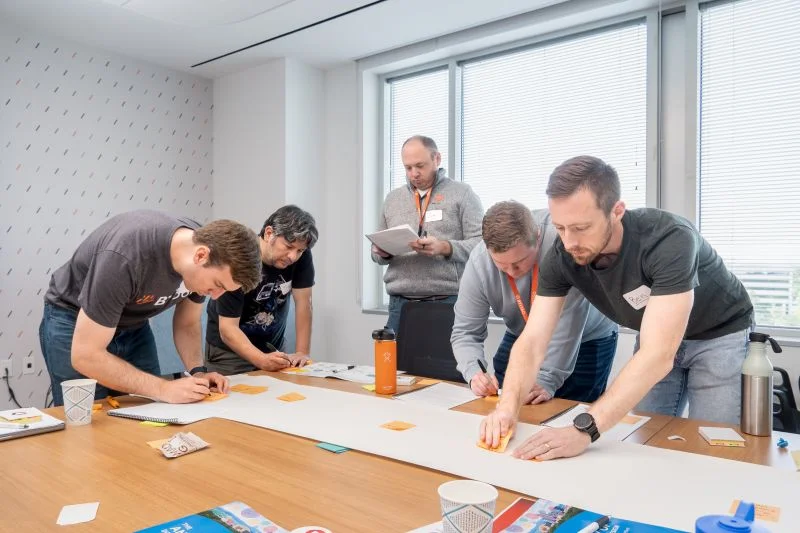
Applied day. The cohort splits into small groups and facilitates 90-minute EventStorming sessions on real business processes from your own organization, open-space style. Paul rotates between groups, coaches in the moment, and leads readouts so the whole room learns from each group.
In-person strongly preferred. Cohort size scoped with you. All three days are part of a single on-site engagement, not separate bookings.
PHASE 2
Your newly trained facilitators start running sessions on their own internal or client work. Paul stays available as a backstop.
Regular sessions to review models the cohort produces, talk through facilitation decisions, and work on whatever came up that the training did not cover.
Paul joins your facilitators in the room for higher-stakes sessions, especially the first one or two with a real customer or enterprise audience, so they are not going in cold. Gradually, Paul fades back.
Typically 2-3 months, scoped to the team and the engagements you want to support.
A cohort of facilitators who can run Big Picture and Process-Level sessions confidently on day one, with the judgment to adapt the method to new contexts.
Every phase produces output on a process your team actually cares about. You end the program with shared models, not just training certificates.
Participants leave speaking the same vocabulary for events, commands, actors, policies, and hot spots, which carries into every future design conversation.
Your facilitators take the 2-day plus day-three format and run it on new domains with new groups, turning one program into a scalable internal practice.
SUCCESS STORY
Fitch Group, Enterprise Architecture
EventStorming training and facilitation with the Enterprise Architecture function as it was being stood up
A team of internal facilitators and evangelists running workshops independently, with self-practitioners applying the principles at the code level
Fitch's Enterprise Architecture team used EventStorming to take a deep dive into complex business processes, including mapping an end-to-end credit rating workflow that spans 12 squads and 25 applications in a single 15-person session. After training and co-facilitation, the practice spread across engineering teams, who began running their own workshops to launch new capabilities and streamline existing ones.
"One of our engineering teams sent me this picture earlier this week, showing how they've started to leverage these workshops on their own, which is exactly what I was hoping for. In this first year and a half we've developed a team of facilitators, evangelists for the workshops, and even a few self-practitioners."
Matt Jones, Head of Enterprise Architecture, Fitch Group — speaking at Explore DDD
"Paul has done a great job of making a 4 day training something I looked forward to daily. Not only was the content great to understand, but the exercises reinformed learning and had great opportunity to have discussions."
Workshop Participant
Financial Services
EventStorming Facilitation
"Creating structure in a collaborative way, understanding that points of disagreement are a good place to dig in deeper Building shared understanding of a problem or a process helps set the stage for solutions and next steps."
Workshop Participant
Financial Services
EventStorming Workshop
Every engagement is scoped to the team and the customer opportunity it is anchored on. A common shape:
In-person delivery is strongly preferred. Virtual and hybrid options are available when geography requires it.
Paul works across enterprise and public-sector environments in unclassified capacities under standard NDAs.
Tell us about the team, the customer opportunity you want to anchor on, and the timing that works for you. We will scope a program that fits.
Schedule a Planning Call